






Buckle up. This is slightly longer (8 min read) than previous posts as it tells a slightly involved but intriguing story that affects every one of us.
For those who don’t want to read very much today, I’ll cut to the chase: If you value certainty to an extreme over curiosity, you may be more likely to be scammed.
If you want to know how I arrived at that, feel free to read below.
Research on Scam Victimization
Before you begin this article in earnest, I must point out that it discusses a collective research product; what I say going forward represents my own opinions on research a team has conducted, and does not necessarily reflect the opinions or viewpoints of any of the other team members or the research sponsors. I will also add that my interpretation of the research is one of several possible ones. I intend for my thoughts, like the research itself, to be stimulating rather than conclusive.
I’ve been fortunate since 2019 to be working with a team exploring how “mental frames” — our beliefs about certain aspects of life — may impact the odds that we will lose money to a scam. The FINRA Investor Education Foundation in conjunction with the Better Business Bureau Institute for Marketplace Trust has generously sponsored the research. So far, we’ve produced two briefs on the subject and I’m happy to announce that this past week we’ve released a third. I’ve written about the earlier briefs which you can view as well.
The research literature on scam victimization has traditionally focused on things like age, race, daily routines, living conditions, education, financial status, and situational factors (e.g., isolation, time pressure) that might predict whether one is likely to lose money to scam. The hope of all researchers in this field is that with better understanding, we can find ways to reduce the number of people who lose money or other things of value to fraudsters.
Our research on “mental frames” has been an attempt to contribute to this understanding. Interestingly, unlike most of the other factors associated with scam victimization, mental frames can be changed or influenced. Studies have suggested that we have ways to change how we think about the world. It’s our hope that because of this, the effort to better understand how beliefs impact our vulnerability to scams will result fewer scam victims.
If by now you’re a regular reader of The Guiding Narrative® here on Substack, you may recognize that “mental frames” are akin to, or can be seen as a product of, our Guiding Narratives®. A Guiding Narrative is the inner story we tell ourselves, mostly subconsciously, about how the world works and our place in it. The beliefs that form this inner story, and the values these beliefs generate, dictate how we interpret and respond to people and events we encounter. Values create mental frames for how we perceive and act in specific life situations.
Our Latest Findings and Speculation
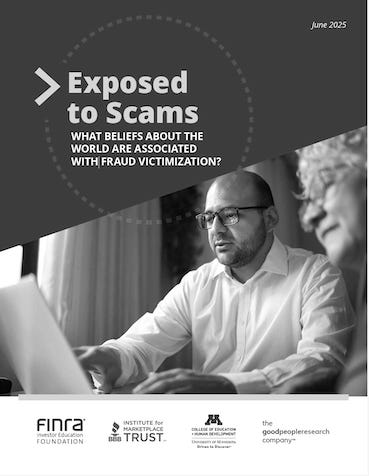
In the research brief released last Thursday, we discuss the possibility that dichotomous thinking (what may be called dualistic, either/or, binary, or black and white thinking) increases one’s odds of losing money in a scam and, conversely, dialectical thinking (what allows for two or more competing truths to coexist and ultimately synthesize into a new understanding – or “gray” thinking) decreases one’s odds.
Dichotomous thinking tends to encourage one to ensure information fits a preconceived mental model while dialectical thinking tends to be open to thinking that information might not fit a preconceived mental model, and new model may be needed. Dichotomous thinking dampens curiosity; dialectical thinking requires it.
I encourage you to read the research brief if you’re curious about the details. Here, I will relay three results that highlight the potential effects of dichotomous vs. dialectical thinking.
Our survey of 3000 U.S- based respondents suggested:
- The stronger you agree that opportunity is a zero sum game with clear winners and losers, the greater the odds you’ll lose money to a scam.
- The stronger you agree that the world is completely unfair, the greater the odds that you’ll lose money to a scam.
- The stronger you agree that the world is sometimes fair and sometimes unfair, the odds are less that you’ll lose money to a scam.
One can see here that survey respondents who tend to indicate they see opportunity and fairness in extreme, absolute terms are more likely to be scam victims. Those who report they see more nuance regarding fairness are less likely to be scammed. While strong beliefs about opportunity and fairness seem like natural vulnerabilities for scammers to leverage, the study’s results suggest a more fundamental, if not latent, pattern.
Wanting things to be true
Consider that if you need to know that one thing is true (either/or thinking), you may be more likely to overlook red flags that contradict your beliefs. If, on the other hand, you’re not as invested in an either/or scenario, you may be more likely to question what you’re perceiving and to investigate what it might mean.
In other words, if it is very important for you to be certain, you may categorize what you’re hearing and seeing to create a sense of certainty; conversely, if you’re comfortable with ambiguity, rather than categorize what you’re hearing and seeing, your impulse more likely is to explore it to understand how you should treat the information.
Scammers rely on their victims to “fill in the blanks” of preconceived mental models. If I convince you a crypto investment will make you tons of money even though I tell you you can’t withdraw your profits when you want to, you may reason that I must know what I’m doing because 1) It appears that I have made money and you are too; and 2) It must be the way these things work and you’re just learning the ropes. You want it to be true that you will be rich and that you made a good decision and that people are mostly honest. So you make it true in your mind. You move toward certainty. The fraudster relies on your need for certainty and consistency to accomplish their ends.
There are some interesting examples of dichotomous thinking from interviews over the years in our research.
- A woman who invested in project promising high ROI even thought she thought it could be a shady deal because she told the “company” she was pregnant and could not believe that anyone would scam a pregnant mother.
- A man who lost $30K of his own money and $300K of borrowed funds in a crypto investment scam because the site that contained his “account” always asked for his government ID which convinced him it must be legit. Also, he got involved in the scam through a woman with whom he had a virtual (online) romantic relationship and he couldn’t conceive she would deceive him.
- A woman who drove to nearby Walgreens and CVS pharmacies at the instruction of a voice on the phone claiming to be an IRS agent so she could buy Apple gift cards in $500 increments to pay back taxes ($2500 in all) she didn’t recall having because she thought the government must be right and could arrest her.
Fulfilling the “truth” of preconceived mental models can lead one to fill in the blanks when perhaps they should not be filled.
Wanting Certainty
While it didn’t make it into the final brief for technical reasons, the survey contained an interesting question, a variable that was associated with the odds of losing money to a scam. The question read as follows, and was to be answered in context of a 7-point scale, ranging from (1) Strongly disagree to (7) Strongly agree:
- Most of the time, I wish I could feel certain about something than feel like there’s more to learn about it, even if there is.
The more one agreed with this statement, the greater the odds that they reported losing money to a scam. That is, if you reported that you prioritize certainty over curiosity most of the time, you were more likely to report that you had been scammed over the prior 12 months.
Is “certainty” a value produced by your Guiding Narrative®?
I’ve discussed in other posts that our Guiding Narrative® produces our values. If in your Guiding Narrative® you tend to view the world as a place where survival depends on knowing “truths,” you may be more likely to be scammed if that scam plays on your strong belief in something. If in your Guiding Narrative® you tend to view the world as a place where ambiguity can be a gateway to greater understanding, you may be less likely to be scammed. The former may cause you to decide rather than question; the latter to question in order to decide.
I’d like to add that being “scammed” is not limited to losing money to a fraudster. The same tendency to seek certainty at all costs over ambiguity can set us up to be manipulated by partners, politicians, family members, and storytellers. Wanting something to be true and finding a way to make it true without exploring plain alternatives to our own thinking is perhaps the most compelling factor in preparing us to be scammed.
In our times, news sources, social media, marketing, and political party platforms increasingly have become vehicles that can reinforce dichotomous thinking, as they attempt to leverage that part of us that wants to be certain about the world, and wants something we preconceive to be true, to be true.
What to do or think about doing
The upshot of this discussion is that, in many areas of life (not all), it may serve you well to be comfortable with ambiguity. Trust in your ability to find your way to an answer after testing different ways to look at the same thing. Defaulting to assumptions because it feels safe may produce the opposite effect.
Alas, while it may seem counterintuitive, having less certain ideas about people and events is likely protective. It increases the odds that you’ll discover something very important that may be hidden from the lens you’ve created for yourself, or has been created for you. Something critical to your survival.
Friends, let’s be smart enough to know what we don’t know.