
(8 minute read)
Pressure
Leaders are under great pressure to guide their organizations wisely in what has become an AI-first world. What are they supposed to do? If they embrace AI transformation, what impact will that have on their organizations? If they don’t, what impact will that have on their organizations?
The research on organizational change may provide the answer leaders are desperately searching for. AI transformations won’t fail or succeed primarily because of choices in technology or execution. They will fail or succeed because of the narrative people inside the organization are quietly telling themselves about what AI means for them — a story leadership rarely hears, often doesn’t suspect, and almost never measures.
Understanding this distinction is critical. It’s the difference between an AI strategy that supports the organization and one that might quietly, gradually, degrade it.
What’s needed for successful AI transformation in organizations? Trust. And trust is accomplished via a shared, organizational narrative around the AI journey and what it means.
Trust Is Not Always What It Appears to Be
To understand the need for and path to trust in the current environment, let’s start with what organizational trust is — the kind that determines whether people will take a risk on what leadership is asking of them.
A foundational academic framework, Mayer, Davis, and Schoorman’s integrative model of organizational trust, defines trust as the willingness to be vulnerable to another party based on the belief that the other party is competent, benevolent, and acts with integrity. Trust, in this view, isn’t a feeling. It’s a bet — a bet that the person or institution asking you to be vulnerable will not use your vulnerability against you, but rather for you.
That definition matters when AI enters the picture. Because what AI asks of employees — cooperate with the rollout, share your workflow, train the system on your expertise, accept new ways of measuring your contribution — is precisely a request to make team members vulnerable. The employee must bet that the organization will handle the gains, the losses, and any displacements fairly.
Employees aren’t deciding whether they trust the technology. They’re deciding whether they trust the people deploying it.
That decision is made based on the inner mental story employees have been quietly assembling for years about the organization, and technology – what to them, is reality.
The Trust Gap
The 2025 Edelman Trust Barometer survey reports that two-thirds of employees from developed economies believe that business leaders won’t be fully honest with them about the impact of AI on jobs. The same research suggests that these workers said they were more motivated to embrace AI at rate a two and a half times greater when they feel their job security is increasing, and that they trust “someone like me” about twice as much as they trust a CEO to tell the truth about what AI will mean for their work.
These gaps aren’t caused by leadership’s lack of attempt to communicate changing policies, per se. They’re rooted in deep-seated, mental stories employees and leaders tell themselves. Hence, importantly, they are hidden from plain view and largely inaccessible by those who hold the narratives.
Leadership is operating on one deep seated mental story framework— a story about productivity, augmentation, opportunity, and shared upside. This, while employees could be operating on a different, deep seated mental story framework — one assembled potentially from a decade of layoff cycles, restructurings dressed up as transformations, and corporate language that promised partnership and delivered displacement. The two stories rarely overlap. Organizations may not even know there are two stories – or multiple divergent stories — actively driving behavior within their organizations.
Scholars who study trust have a term for this kind of divergence: perceived trustworthiness is not the same as actual trustworthiness. What matters operationally is not what leadership intends, or even what leadership does, but the meaning employees assign to what leadership does, filtered through everything they’ve experienced and internalized in their personal lives and forces they’ve witnessed external to their personal lives. This narrative which guides their behavior is most often invisible to leadership; likewise, leadership’s narrative, not the verbalized one espoused in town halls and blog posts but the latent one driving leadership behavior, is invisible to employees. It’s important at this point to restate: these narratives that drive decisions and behavior are mostly invisible to those who are driven by them – leadership, employee, or otherwise — as they are assumed, baked deep into their respective mental lives.
Sensemaking: How Trust Is Derived from a Story
Karl Weick’s work on organizational sensemaking offers a useful frame for what’s happening when AI is introduced into a workplace.
Weick’s thesis: organization members don’t respond to events. They respond to the meaning they assign to events, and that meaning is constructed retrospectively, collectively, and largely below conscious awareness. When something ambiguous happens — a memo, a pilot program, a new platform, a sudden round of consultants — people reach for the existing narrative they’ve been cultivating about the organization and use it to interpret what they’re seeing.
To illustrate this, imagine, for example, that if an existing employee’s internal narrative assumes “leadership tells us the truth, follows through, and protects people who do good work,” the employee might interpret AI transformation as an investment in capability. Now imagine the narrative assumes that “leadership tells us what they want us to hear, follows through when it’s convenient, and the people who got laid off last time were our friends,” the employee interprets the AI rollout as a setup. This is then the outward story they tell their peers and the public. It becomes folklore, which may be untethered to leadership’s actual intentions and policies.
Same memo. Same pilot. Same CEO video. Two completely different organizational results.
The organization members’ always on, inner “story” – the narrative that unconsciously drives how they make meaning of the world – is the pivotal variable, the one that becomes the most important unit of analysis begging to be heard correctly. And the narrative was written and adopted long before AI showed up.
The Silence Mechanism
There’s a deeper dynamic that the literature captures with unusual precision — and that most AI rollout planning could miss entirely.
Amy Edmondson’s research on psychological safety, now studied across decades and thousands of teams, demonstrates something that should be sobering for anyone running an AI initiative. When employees don’t feel safe — when the narrative they’re living by says that raising concerns will be costly — they don’t resist openly. They go quiet. They comply on the surface. They participate just enough to avoid being flagged. And they silently withhold the very thing the organization needs most from them: their real understanding of how the work gets done.
This is the silence mechanism, and it is catastrophic for AI transformation specifically.
AI systems learn from what people are willing to give them. They become useful when the people closest to the work are willing to expose their methods, reveal edge cases, flag where the model is wrong, and contribute the tacit knowledge that exists in their hands and instincts. All of that requires vulnerability. All of that requires trust. And in an organization where the internal narrative assumes “they’re building the thing that replaces you,” that vulnerability simply doesn’t present itself. People hand over the minimum. The system trains on surface information. The transformation produces a thin, brittle version of what was promised.
Leadership may see underwhelming adoption metrics and conclude the technology needs tuning. Is technology the problem? Or is it that an entire workforce may have decided, quietly and collectively, not to fully show up. And was that decision made not in response to AI, but in response to an inner story about what the organization would do with the knowledge the workforce contributes to it?
The Multiple Organizations Inside Every Organization
Zoom out from any single team, and a third pattern becomes visible — one that may be the most destabilizing of all.
Recent global research finds that nearly two-thirds of people managers regularly use AI at work, while only one in four non-managers do. This research suggests that executives are roughly two and a half times more likely than associates to trust their CEO to tell the truth about what is happening inside the organization. Across income brackets, the people most exposed to displacement are also the people who feel most likely to be left behind by the transition.
What this describes is not one organization adopting AI. It is two (or more) organizations occupying the same entity, each living inside a different reality about what is happening and why.
The leadership narrative could be roughly: we are investing in productivity, this will create opportunity, those who lean in will benefit, those who don’t need to adapt. The employee narrative may be closer to: the people deciding this don’t do my work, don’t see what I see, and won’t bear what I bear if they get it wrong. Neither narrative is fully accurate. Neither is fully wrong. And neither is being articulated openly inside the organization, which is precisely what makes them so corrosive.
These two stories don’t meet in company planning documents. They meet when a frontline employee is asked to teach the system how they do their job and quietly decides what to share and what to keep.
The Insight + Measurement Problem
Here is where the challenge becomes organizational as much as strategic.
The tools most companies rely on to understand their organizations — engagement surveys, eNPS scores, pulse polls, sentiment analytics, even most “listening tour” exercises — are built to measure the surface of what employees are willing to say in response to questions their employer asks them. They are structurally incapable of surfacing the internal narrative employees are living by — the subconscious story they use to decide whether the next request from leadership is one they should fully invest in or quietly hedge against.
And there’s a compounding problem: leaders are often confident they already know the story they need to know. They design town halls and listening sessions. They talk to their direct reports. They visit sites. They get briefings. They emerge with a picture of the organization that is largely composed of inputs or filtering from people whose narrative most resembles their own — and almost entirely missing the inputs from people whose narrative is the one most likely to determine whether the AI initiative succeeds.
The gap isn’t visible from inside the C-suite. It’s only audible from inside the employee’s own, mostly subconscious but active, imagination. And by the time it shows up in metrics — regrettable attrition, low AI adoption, the curiously inert pilot, the sudden union conversation — the organizational story has already been written. The internal narratives driving behavior has already done their work. Leadership is now responding to the last chapter of something they never knew was being authored.
What It Takes to Lead in an (uncertain) AI-first World
All of this points toward a different set of questions, and a different set of assumptions, than most AI transformation leaders may anticipate and use.
Consider the core, conventional question: How do we communicate the AI strategy more effectively? The more important questions may be: What story are our people already telling themselves about us? About themselves? Why do these stories exist — and can our AI plan be driven by a story all members of the organization can see themselves in?
Answering those questions requires methods designed to go beneath stated attitudes and surface-level engagement scores that surveys or listening sessions produce. It requires disinterested, third-party, participant-observation research. It takes a trained team of researchers, generally in person, to immerse themselves in and understand the meaning of a group’s culture and experience from the group’s point of view. It requires witnessing, watching, and listening for the assumptions, beliefs, values, and social norms that organize how your people make meaning of their own roles and of leadership behavior. These are expressed in a variety of forms the trained researchers can triangulate.
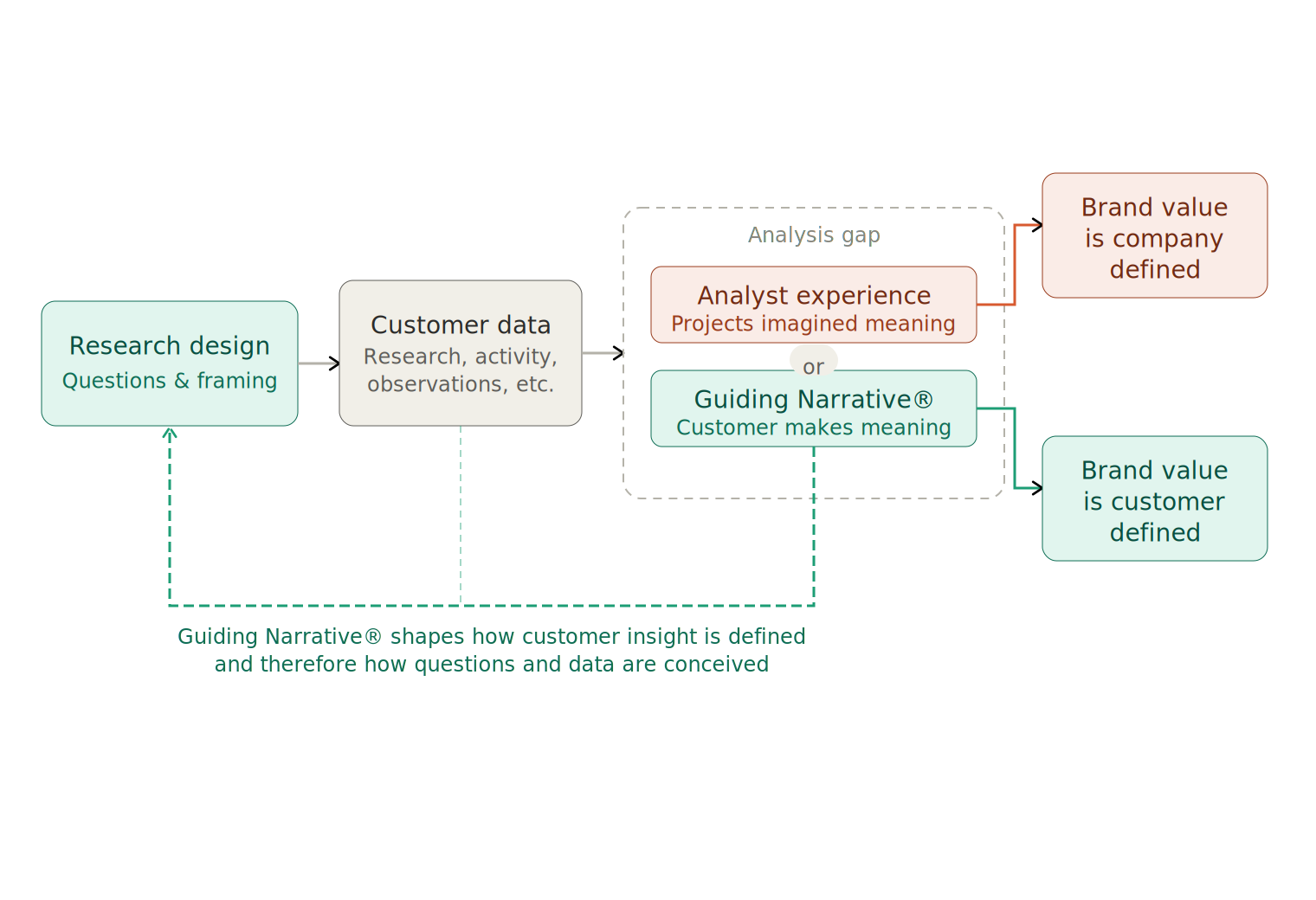
This method of learning and reconciling how all organization members make meaning of their situation via deep-seated, internal narratives is one we employ at The Good People Research Company – what we call the Guiding Narrative® method. Using this method, we surface, reconstruct, understand, and validate (with the groups themselves) the quiet, inner narratives that shape employee and leadership meaning making, and are expressed in culture and behavior. We then work with a cross section of organization members in light of this new insight to develop a shared Guiding Narrative® that ensures a more unified, trust-inspired organization moving forward. This becomes possible because the shared Guiding Narrative® is grounded in what organization members already assume, believe, and value.
This Guiding Narrative® method is based on a 2400 year long tradition of philosophical, psychological, and social inquiry, and honed in applied practice over 25 years in diverse organizations and settings. The approach is markedly different from normal surveys, focus groups, interviews, and listening sessions because it assumes that behavior is driven by an inner narrative, largely inaccessible to the person being studied, and therefore unlikely to be expressed directly in response to questions devised by a researcher. Rather, the inner narrative becomes evident to the trained eye and ear through techniques designed to surface it, dispassionately interpret it in proper context, and validate it with the individuals and group being studied. In the end, the Guiding Narrative® itself, now surfaced, articulated, and validated, becomes the trusted framework for understanding the types of questions to consider for all organizational stakeholders, and how to interpret their responses and behavior.
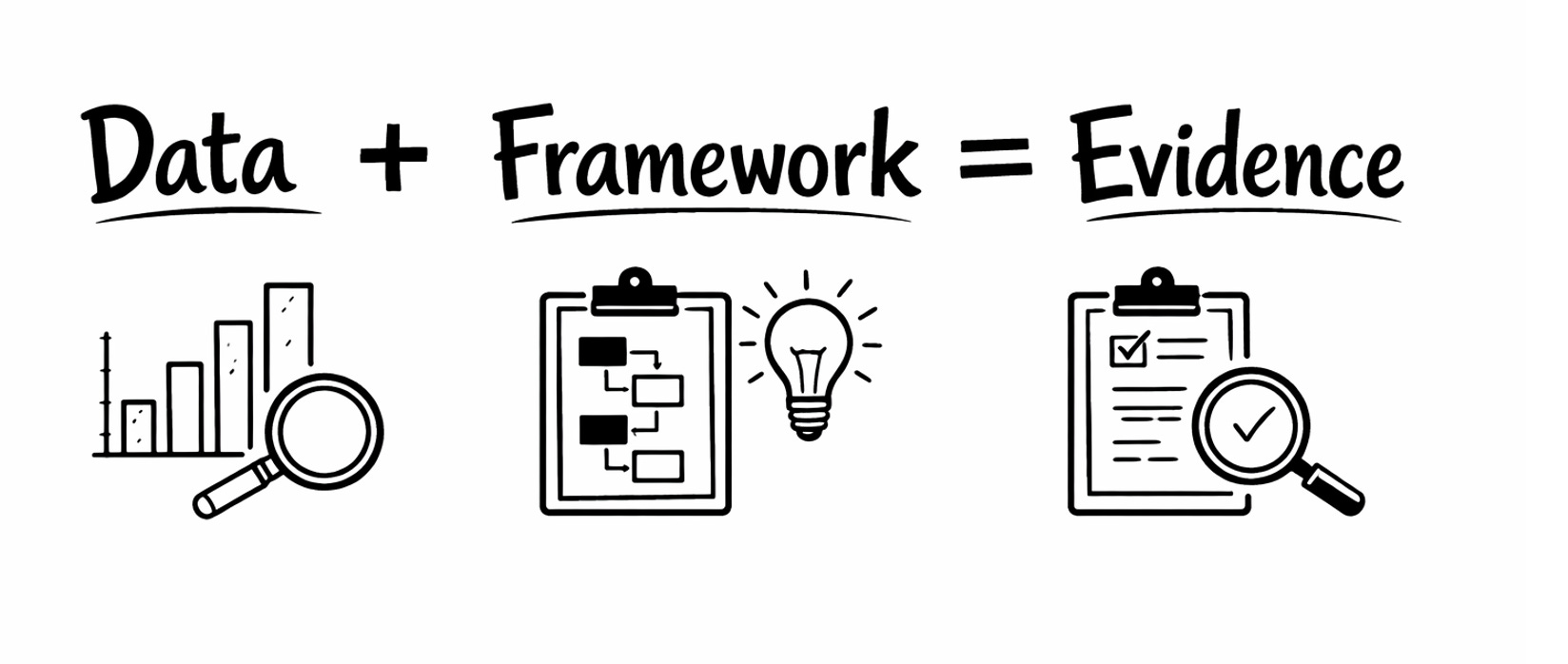
Using a grounded, articulated narrative that exists in the mind of organization members to interpret data and signals, stands in stark contrast to using the inherently eclipsed and biased imagination of the leader or hired researcher, and is thus reassuring for organizational change efforts.
These techniques, while more involved than typical survey, focus group, and interview methods, can be right-sized to organizations based on their size, complexity, and geographic distribution. The depth of the research is not an inherent obstacle. Ultimately, it is the underlying approach to viewing and understanding human behavior, not the time and labor involved per se, that is the key differentiating factor in what makes Guiding Narrative® an effective aid to strengthening organizations, particularly through periods of profound change.
Accurately grounded in the insight they’ve gained into the narratives that drive them, organizations that know how to ask the right questions and understand the proper context to interpret responses have an extraordinary advantage going into the AI era. They can detect narrative drift across parties before it causes an adoption failure. They can distinguish between basic communication problems and structural trust problems. They can hear the story their workforce is telling about them at all levels and understand what it means before it becomes a collective story they can’t rewrite. And they can do the one thing that moves the needle on AI adoption: make the new technology a chapter in a story their people already believe in, and therefore one that they inherently trust.
The research is clear about what likely determines the success or failure of AI transformation as it creates uncertainty. It usually isn’t technology. It’s stories— ones that go unheard until it is already too late to respond to them.
Craig Honick is the founder of The Good People Research Company and creator of the Guiding Narrative® methodology — an applied ethnographic approach that surfaces the internal narratives people use to make meaning, build trust, and decide how to show up inside and outside the workplace. The Good People Research Company works with purpose-driven leaders navigating the human dimensions of AI transformation.
Sources
Trust as willingness to be vulnerable
Mayer, R.C., Davis, J.H., & Schoorman, F.D. (1995). An Integrative Model of Organizational Trust. “Academy of Management Review”, 20(3), 709–734.
https://www.jstor.org/stable/258792
Schoorman, F.D., Mayer, R.C., & Davis, J.H. (2007). An Integrative Model of Organizational Trust: Past, Present, and Future. “Academy of Management Review”, 32(2), 344–354.
https://journals.aom.org/doi/10.5465/amr.2007.24348410
Sensemaking and the construction of organizational meaning
Weick, K.E. (1995). “Sensemaking in Organizations”. Thousand Oaks, CA: Sage Publications.
Weick, K.E., Sutcliffe, K.M., & Obstfeld, D. (2005). Organizing and the Process of Sensemaking. “Organization Science”, 16(4), 409–421.
Jones, Michael Owen, Michael Dane Moore, and Richard Christopher Snyder, eds. (1988). Inside Organizations: Understanding the Human Dimension. Newbury Park, CA: Sage Publications.
Psychological safety and the silence mechanism
Edmondson, A.C. (1999). Psychological Safety and Learning Behavior in Work Teams. “Administrative Science Quarterly”, 44(2), 350–383.
Edmondson, A.C. (2018). “The Fearless Organization: Creating Psychological Safety in the Workplace for Learning, Innovation, and Growth”. Hoboken, NJ: Wiley.
The AI trust gap
2025 Edelman Trust Barometer Flash Poll: Trust and Artificial Intelligence at a Crossroads (November 2025).
https://www.edelman.com/trust/2025/trust-barometer/insights/ai-trust-crossroads
2024 Edelman Trust Barometer Special Report: Trust at Work.
https://www.edelman.com/trust/2024/trust-barometer/special-report-trust-at-work
Trust as an organizational performance variable
Dirks, K.T., & Ferrin, D.L. (2002). Trust in Leadership: Meta-Analytic Findings and Implications for Research and Practice. “Journal of Applied Psychology”, 87(4), 611–628.
Research Tradition underpinning the Guiding Narrative® Method:
Most of the theories, scholarly work, and applied experience that underpins the Guiding Narrative® method can be found in a Substack post outlining a 2400 year lineage of thinkers from philosophy, psychology, anthropology, sociology, economics, and management. The post argues that inquiry about human behavior — from the formation of initial research questions and hypotheses to final analysis — is defined almost entirely by the mental framework, or contours of imagination, applied to make meaning of the behavior being studied.
Guiding Narrative® is based on the premise that the meaning of behavior displayed by a person or group is most accurately understood using the internal mental framework the person or group being studied uses to make meaning, not meaning making produced by the researcher’s mental framework, imagination, and experience. The latter is most is most often the case in modern social science, despite a long history of theory and application that would support the former.